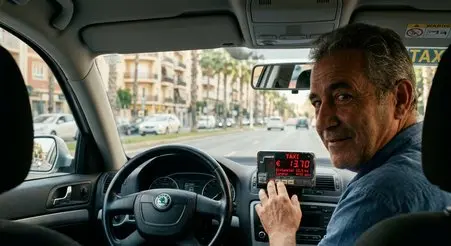
If I had to choose the question customers have asked me most often throughout my years in the profession, it would be this one.
There are many misconceptions about how taxi meters work, usually due to a lack of understanding.
When customers ask me this question, I tell them that under normal driving conditions, the meter charges by distance. This usually leaves them puzzled. To help them understand, I give them an example: imagine an ideal 50 km journey with no traffic or interruptions, where two cars set off at the same time, one travelling at 200 km/h and the other at 70 km/h. When they both complete the journey, which one will have the higher fare on the meter?
— The one that travelled at 70 km/h, they usually reply.
— No, I answer, leaving a hint of surprise in the air.
It’s understandable: intuition suggests one thing, while mathematics tells us another. In fact, in this ideal scenario, there would be no winner or loser: both taxi meters would show the same fare.
The reason is simple: if both vehicles cover exactly the same 50 kilometres without stopping, both meters are charging by distance. Speed will only determine how soon or how late they arrive.
Customers look surprised, but they understand that distance is what matters in this scenario. That is, until we reach a traffic light. They see the meter continuing to run even when we’re stationary and say to me: “But wasn’t this charging by distance?”
Let’s pause the scene here and look at a key concept: changeover speed (also known as the changeover rate).
What is changeover speed?
We could define changeover speed as the precise threshold at which the taxi meter switches between charging modes.
The obvious question is: what is that threshold speed? There is no universal answer, but there is a mathematical one. The calculation follows a specific formula (let’s sharpen our pencils):
Changeover speed (km/h) = Waiting-time rate (€/h) / Rate per kilometre travelled (€/km)
A practical example
Let’s assume that the waiting-time rate is €20 per hour and the rate per kilometre travelled is €1.50:
€20/h ÷ €1.50/km = 13.33 km/h
That would be the changeover speed for this particular fare structure, since both the hourly rate and the rate per kilometre vary depending on the applicable tariff.
- Below 13.33 km/h: The vehicle is moving very slowly or is stationary → the meter charges by time.
- Above 13.33 km/h: The vehicle is moving at a normal speed → distance takes over.
Therefore, on a typical urban or interurban journey, the final fare will usually be a combination of both charging methods. However, in urban areas, the final amount is more heavily affected by the changeover speed. In other words, the cost of a journey within the city is harder to predict, especially during rush hour.
So, how can I find out the exact price of a journey?
The reality is that you can’t know for certain, although an estimate is possible… until now.
In Alicante, for the past few months, it has been possible to book an urban taxi journey at a fixed price, so passengers know how much they will pay before getting in. But that’s a story for another day.
Further information
In the Downloads section, you can find the official fares for the current year. This will give you a more accurate idea of the price per kilometre and the waiting-time rate for each time period.